IP-rich EU firms face up to €150bn funding gap says EUIPO report: concludes IP-backed finance could be the answer
20 Apr 2026


Author
Martin Croft
PR & Marketing Manager
Photo by Fabian Kleiser on Unsplash
A new report from the European Union Intellectual Property Office (EUIPO), IP-backed finance in Europe, estimates that the total EU SME credit gap could be as high as €365bn a year, with IP-rich firms facing a funding gap of between €70bn and €150bn annually.
The report observes that, with the right framework, IP-backed finance could mobilise €30bn to €120bn a year, generating up to €750bn in GDP impact across the EU over a decade.
The report's key conclusions are that although Europe produces world-class research and entrepreneurial talent, the EU struggles to commercialise and scale innovative firms. “A key constraint is the limited ability to finance IP-rich companies, which slows productivity growth and weakens global competitiveness.”
In addition to the credit gap mentioned above, the report says:
IP assets are difficult for financial institutions to assess because of information asymmetry, uncertain value, lack of comparable data and dependence on firm-specific knowledge. This leads to conservative lending practices or exclusion of IP altogether.
Underdeveloped secondary markets, lack of harmonised legal frameworks and limited recognition of intangible assets in accounting systems make IP largely invisible in financial decision-making.
IP valuation remains costly, complex and inconsistent, with a shortage of experts and limited data. This prevents lenders from confidently integrating IP into financing decisions.
The EUIPO points out that “while IP-intensive industries generate around 48% of EU GDP and 31% of employment, many companies, particularly SMEs and start-ups, struggle to leverage their IP assets to access finance. As a result, some high-potential firms relocate outside the EU in search of better funding conditions.”
By positioning intellectual property as a financial asset, not just a legal tool, the EUIPO says this report is a contribution to the broader debate on how to strengthen Europe’s competitiveness sparked off by the Letta and Draghi reports. A key objective is to ensure that innovation created in Europe is also developed and scaled within it.
The report identifies three barriers to the adoption of IP finance.
First, IP assets do not behave like conventional collateral: information asymmetry makes risk assessment difficult, IP value depends on complementary assets that cannot be easily transferred, and each IP asset is unique, with little comparable transaction data.
Second, fragmented rules and missing markets reinforce the problem: secondary markets for IP are weak, accounting standards restrict the recognition of internally generated intangibles, legal provisions governing security rights in IP are not harmonised across Member States, and the prudential banking framework reduces the attractiveness of IP as collateral.
Third, IP valuation remains costly: bespoke valuations are expensive and disproportionately so for SMEs, the pool of qualified valuation experts is small, and limited transaction data makes it difficult to validate outcomes.
The report says: “Together, these barriers form a vicious circle: without transactions, no data accumulates; without data, risk assessment remains conservative; without credible risk assessment, no instruments can scale.”
Addressing these barriers, the report’s authors conclude, “requires coordinated action across all three dimensions simultaneously.”
The report identifies three main pillars to build an IP finance system on:
Facilitating access to banking credit
Strengthening IP valuation practices
And facilitating finance beyond banking credit
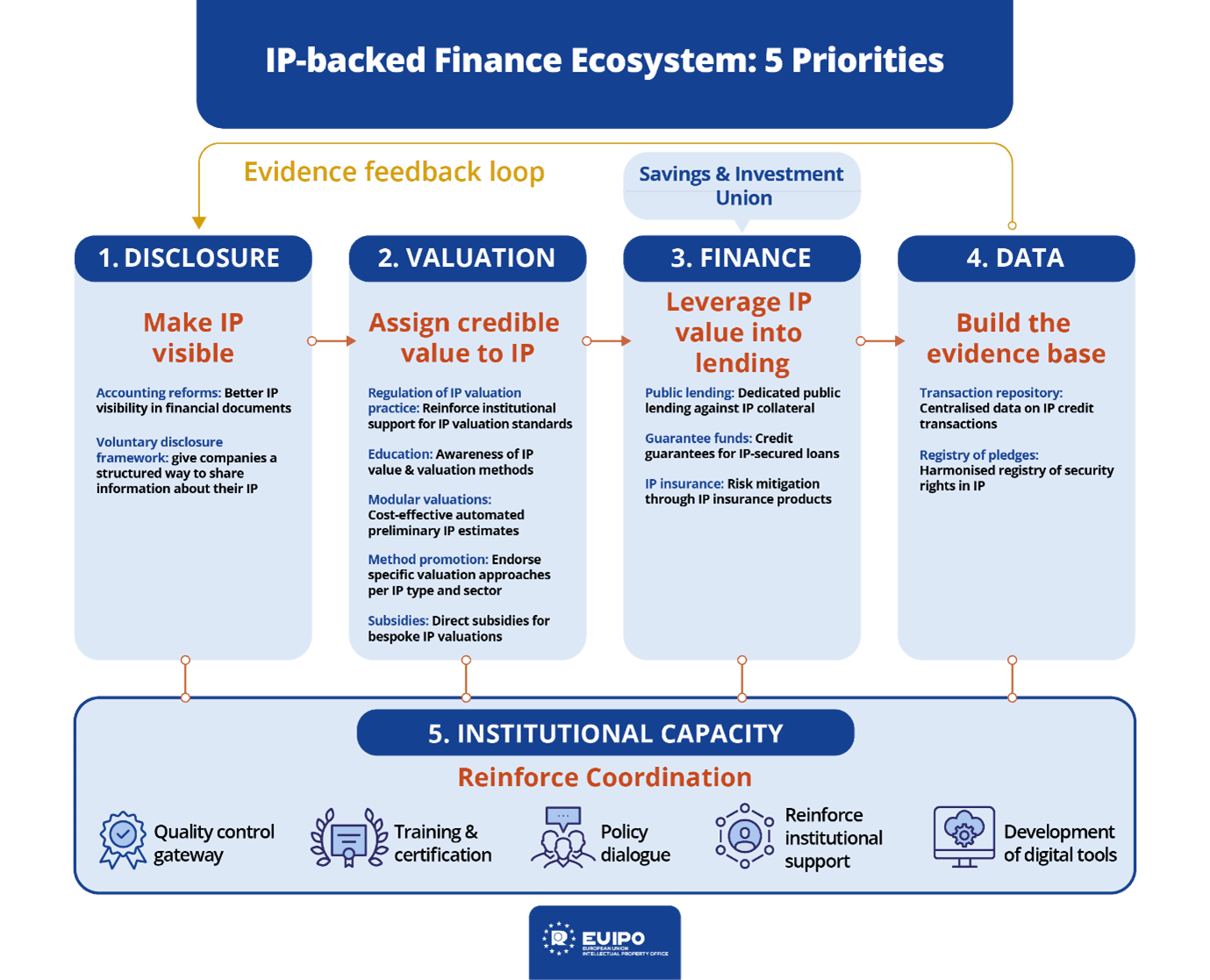
The report has then organised what it says are the “most actionable” steps into five sequenced priority areas, “aiming at laying the foundations for a functional IP-backed finance system in Europe.”
The EUIPO has provided an infographic covering the five pillars and the actionable points (see below).